Recycled polyester filling vs first-use polyester
What’s inside our soft toys, and why it matters
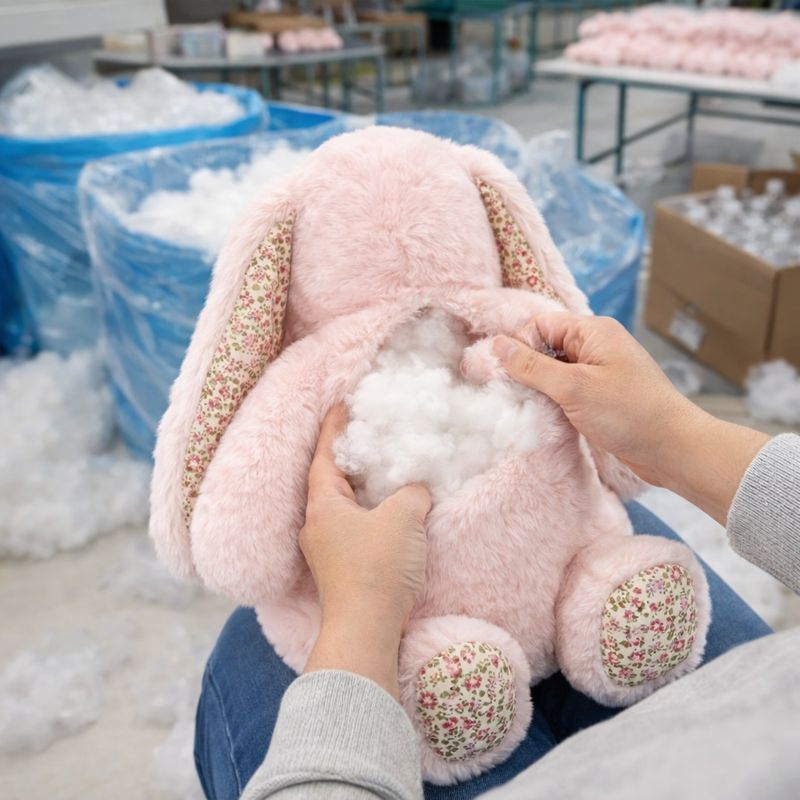
When choosing a soft toy, what you see and feel on the outside is important — but what’s inside matters too. One of the most common questions we’re asked is why we use recycled polyester filling rather than first-use (virgin) polyester, or why we don’t use natural alternatives like wool or hemp.
The answer isn’t about following trends or chasing labels. It’s about balancing science, safety, performance, and long-term impact — and making choices that genuinely improve how our products are made and used.
Where polyester filling comes from (at a high level)
Polyester is a man-made fibre derived from PET (polyethylene terephthalate) — the same family of material commonly used in drink bottles. In soft toys, polyester filling is widely used because it is:
-
Lightweight and soft
-
Resilient and long-lasting
-
Washable and quick-drying
-
Stable and safe for children’s products
There are two main types of polyester filling:
-
First-use (virgin) polyester, made from newly produced plastic derived from fossil fuels
-
Recycled polyester, made by processing existing plastic — most commonly PET bottles — into new fibre
Both ultimately become the same type of soft, springy fibre once inside a finished toy.
Recycled polyester vs first-use polyester: the pros and cons
First-use (virgin) polyester filling
Pros
-
Very consistent in feel and appearance
-
Can feel slightly silkier when handled as loose fibre
-
Predictable supply at scale
Cons
-
Made from newly extracted fossil fuels
-
Increases demand for new plastic production
-
Part of a linear system: make → use → discard
Recycled polyester (rPET) filling
Pros
-
Uses plastic that already exists, rather than creating new plastic
-
Generally requires less energy and produces fewer emissions than first-use polyester
-
Helps divert plastic waste from landfill
-
Performs just as well once inside a finished toy
Cons
-
Still a plastic (it’s not a perfect solution)
-
Quality can vary slightly between suppliers if not carefully specified
Why we choose recycled polyester filling
We’ve chosen recycled polyester filling because it offers the best balance between environmental responsibility, product performance, and safety.
One important point is often overlooked:
Once the filling is sealed inside a soft toy, the difference between recycled and first-use polyester is essentially unnoticeable.
The softness, comfort, and cuddliness of a toy are driven far more by:
-
the outer fabric,
-
the pattern and proportions,
-
and how the toy is constructed,
than by whether the internal fibre is recycled or virgin.
Using recycled polyester allows us to:
-
reduce reliance on new fossil-based plastic,
-
maintain the softness and durability families expect,
-
and make a meaningful improvement without compromising quality or safety.
It’s not about being perfect — it’s about making better choices where they genuinely matter.
Why not natural fillings like wool or hemp?
We’re often asked why we don’t use natural or organic fillings instead. While these materials have many positive qualities, they’re not always suitable for children’s soft toys.
Some of the challenges include:
-
Consistency: natural fibres can compact or shift over time
-
Care and hygiene: soft toys are washed, chewed, and dragged around, and need to dry reliably
-
Allergies and sensitivities: some natural fibres can irritate sensitive skin
-
Safety and compliance: children’s products require predictable behaviour under testing and real-world use
For now, recycled polyester allows us to meet strict safety standards while reducing environmental impact compared with first-use polyester.
How many plastic bottles are in a soft toy?
A simple way to visualise recycled polyester is to think in terms of plastic bottles by weight.
A typical 500 mL PET bottle weighs roughly 15–25 grams. Using this as an average, we can estimate how much recycled plastic is used in a toy based on its filling weight.
Approximate examples
-
Small soft toy (around 60 g of filling)
≈ 3 plastic bottles -
Medium soft toy (around 120 g of filling)
≈ 6 plastic bottles -
Large soft toy (around 250 g of filling)
≈ 12–13 plastic bottles
These figures aren’t about precision — they’re about understanding material use in real, tangible terms. Choosing recycled filling means plastic already in circulation is given another useful life, rather than new plastic being created.
A final note on impact — and why quality matters
Recycled polyester isn’t a silver bullet. It doesn’t remove plastic from the world, and it doesn’t solve every environmental challenge.
What it does do is:
-
reduce demand for new plastic,
-
make use of material that already exists,
-
and support a more circular approach to manufacturing.
This thinking is closely tied to how and why we design our products.
We don’t believe soft toys should be the fast fashion equivalent of children’s products — made quickly, used briefly, and easily discarded. Instead, we focus on creating toys that are thoughtfully designed, carefully made, and built to last.
By investing in quality materials, strong construction, and timeless designs, we aim to create soft toys that can be:
-
loved every day,
-
washed and cared for,
-
passed on to siblings or friends,
-
and enjoyed well beyond a single season or trend.
Longevity matters. A toy that stays in use for years — rather than months — has a far lower environmental footprint than one that needs to be replaced again and again.
Choosing recycled polyester filling is just one part of that broader philosophy: making considered choices that balance comfort, safety, durability, and environmental responsibility, so our toys can be enjoyed for as long as possible.
Transparency note
The bottle comparisons above are based on industry-typical average bottle weights and approximate filling weights. Actual bottle weights, recycling pathways, and filling volumes vary by product and supplier. These figures are intended as a helpful guide to understanding material use, not as an exact count.